


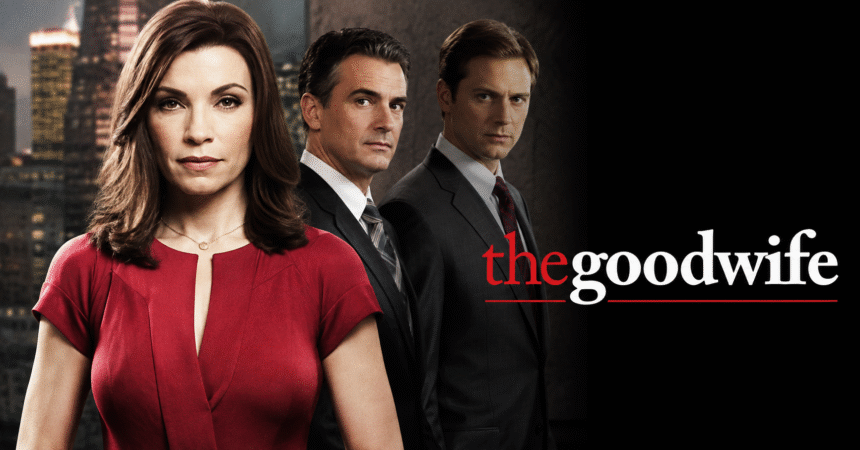
The Good Wife remains one of the most respected legal dramas of its generation, blending courtroom battles, political intrigue, complicated relationships, and deeply personal storytelling. Starring Julianna Margulies as Alicia Florrick, the CBS series followed a woman rebuilding her professional life after her husband became embroiled in a public scandal. What began as a story about a politician’s wife finding her independence developed into a sophisticated seven-season drama about ambition, loyalty, power, and identity.
Premiering in September 2009, the series ran for seven seasons before concluding in May 2016. Created by Robert King and Michelle King, the show became known for its intelligent writing, exceptional ensemble cast, and willingness to explore difficult moral questions without providing easy answers.
The Story Behind The Good Wife
At the center of The Good Wife is Alicia Florrick, a mother and former attorney whose carefully structured life changes dramatically after her husband, Peter Florrick, is caught in a highly publicized political and personal scandal.
After years away from legal practice, Alicia returns to work to support herself and her children. She joins the Chicago law firm Stern, Lockhart & Gardner, where she begins the difficult process of rebuilding her career.
The premise sounds straightforward, but the series quickly moves beyond the idea of a betrayed wife. Alicia is not simply reacting to her husband’s mistakes. She is discovering who she is when the identity she built around marriage, family, and social expectations no longer feels secure.
That transformation became one of the show’s greatest strengths. Rather than presenting Alicia as a flawless heroine, the writers allowed her to make questionable decisions, experience setbacks, pursue ambition, and sometimes surprise even herself.
Julianna Margulies Made Alicia Florrick Unforgettable
Julianna Margulies carried the series with a performance that balanced restraint and emotional complexity. Alicia often appears composed in public, even when her personal life is falling apart. Margulies made those quiet moments as meaningful as the dramatic courtroom scenes.
Her performance also helped establish Alicia as an unusually complicated television protagonist. She could be compassionate and calculating, vulnerable and ambitious, principled and occasionally ruthless.
Margulies received major recognition for the role, including a Golden Globe, two Emmy Awards, a Critics’ Choice Award, and two Screen Actors Guild Awards. The series itself ultimately received 39 Emmy nominations and won five Emmy Awards across categories.
Her success demonstrated how a network television drama could build an entire story around a mature female character without reducing her to a romantic storyline.
A Brilliant Ensemble Cast
Although Alicia is the emotional center, the supporting cast helped give the series its distinctive personality.
Christine Baranski played Diane Lockhart, a formidable attorney whose confidence, intelligence, and professionalism made her one of the show’s standout characters. Diane was more than Alicia’s boss or colleague; she represented the kind of accomplished professional Alicia was gradually becoming.
Josh Charles played Will Gardner, Alicia’s former law-school friend and complicated romantic connection. Their relationship became one of the show’s most emotionally important storylines.
Archie Panjabi brought enormous energy to the role of Kalinda Sharma, a highly skilled investigator known for her secrecy, confidence, and unconventional methods. Matt Czuchry played Cary Agos, a young attorney whose career repeatedly intersects with Alicia’s professional journey.
The cast also included Chris Noth as Peter Florrick, Alan Cumming as Eli Gold, Zach Grenier as David Lee, and Carrie Preston as the eccentric but brilliant attorney Elsbeth Tascioni.
Why the Legal Stories Felt Different
One of the biggest achievements of The Good Wife was its ability to make legal cases feel connected to everyday life.
The courtroom stories were not simply about winning or losing. They often explored questions surrounding privacy, technology, politics, morality, free speech, corporate power, and personal responsibility.
A case could begin with an apparently simple legal dispute and gradually reveal a much larger ethical problem. Characters frequently had to choose between what was legally permissible and what they personally believed was right.
This approach gave the series a more realistic feeling than a traditional courtroom procedural. Lawyers were not portrayed as people who always knew the correct answer. Instead, they were professionals working within imperfect systems while dealing with their own personal interests.
The Political World Added Another Layer
Peter Florrick’s political career provided an important parallel storyline throughout the series.
As Peter attempted to rebuild his public reputation, Alicia increasingly found herself connected to Chicago’s complicated political environment. Campaigns, elections, prosecutors, political consultants, lobbyists, and personal scandals became part of the show’s larger world.
Yet politics was rarely treated as a simple battle between heroes and villains. The writers frequently showed how compromise, strategy, loyalty, ambition, and public perception could influence political decisions.
Eli Gold, played by Alan Cumming, became particularly important in this area. His energetic personality and political instincts provided both comic relief and serious dramatic tension.
Alicia’s Evolution Was the Real Story
The most interesting part of The Good Wife is arguably not the courtroom cases or political scandals. It is Alicia’s evolution.
When viewers first meet her, she is largely defined by her role as Peter’s wife and the mother of their children. Returning to professional life forces her to rediscover skills and confidence that had been dormant for years.
Over time, Alicia becomes increasingly independent. She develops professional relationships, builds her reputation, experiences romantic complications, and learns that success often comes with difficult compromises.
Her journey is not a simple transformation from powerless woman to powerful attorney. Instead, the series shows how becoming independent can create new moral and emotional problems.
Alicia gains control over her life, but that control does not automatically make her happier.
The Show Was Never Afraid of Major Changes
The series became famous for taking unexpected turns. Characters who seemed central to the story could leave, relationships could collapse, and professional alliances could change quickly.
One of the most significant moments came with the death of Will Gardner, played by Josh Charles, in 2014. The event dramatically affected Alicia and changed the direction of the series.
Rather than simply returning to normal afterward, the writers allowed the consequences to shape Alicia’s decisions and relationships.
This willingness to accept permanent consequences helped keep the drama unpredictable.
A Critically Acclaimed Television Legacy
By the time The Good Wife reached its final season, it had established itself as one of television’s most decorated legal dramas.
The series was named an AFI Television Show of the Year twice and received major recognition from organizations including the Peabody Awards, Television Critics Association, Writers Guild of America, and Emmy Awards.
Its success was especially significant because it combined traditional network television storytelling with increasingly sophisticated serialized drama.
The series also helped create a larger television universe. Diane Lockhart later became the central character of the spin-off The Good Fight, while Elsbeth Tascioni eventually became the focus of the CBS series Elsbeth. The latter continued the character’s story after her appearances in the earlier shows.
How The Good Wife Ended
CBS announced in February 2016 that the seventh season would be the show’s final chapter. The creators, Robert and Michelle King, welcomed the opportunity to bring the story to a planned conclusion rather than continuing without the original creative leadership.
The final episode aired on May 8, 2016, bringing Alicia’s seven-year journey to an end. The conclusion remained consistent with the show’s larger themes: professional ambition, personal consequences, complicated morality, and the difficulty of defining yourself through relationships.
Rather than offering a completely comfortable ending, the finale left viewers with an ending designed to provoke discussion.
That choice reflects what made the series distinctive in the first place. It trusted its audience to think about what happened instead of explaining every emotion or consequence.
Why The Good Wife Still Matters
Years after its finale, The Good Wife continues to attract viewers because its central themes remain remarkably relevant.
The show explored workplace ambition, political scandals, marriage, motherhood, professional competition, media scrutiny, and the complicated choices people make when their private lives become public.
Its greatest achievement may be that Alicia Florrick was never presented as simply “good” or “bad.” She was human.
That complexity made the character believable and gave the series lasting emotional value. The legal cases may provide the weekly drama, but Alicia’s changing understanding of herself gives the show its deeper meaning.
Frequently Asked Questions
What is The Good Wife about?
The series follows Alicia Florrick, a woman who returns to her legal career after her husband’s political and personal scandal forces her to rebuild her professional and personal life.
Who played Alicia Florrick?
Julianna Margulies portrayed Alicia Florrick throughout the series. Her performance earned several major acting awards, including two Primetime Emmy Awards and a Golden Globe.
How many seasons does The Good Wife have?
The series has seven seasons. It premiered in 2009 and concluded in 2016 after more than 150 episodes.
Who created The Good Wife?
Robert King and Michelle King created the series. They also played an important role in shaping its long-running story and distinctive mixture of legal, political, and personal drama.
Is there a spin-off of The Good Wife?
Yes. The Good Fight continued the universe with Christine Baranski’s Diane Lockhart as its central character. Carrie Preston’s Elsbeth Tascioni also later became the lead character of Elsbeth, another series created within the same television universe.
Conclusion
The Good Wife became much more than a legal drama about a politician’s marriage. It developed into a thoughtful portrait of ambition, independence, loyalty, power, and personal reinvention. Julianna Margulies gave Alicia Florrick the emotional depth needed to carry seven seasons, while the outstanding ensemble and sharp writing created a world that remained unpredictable.
Its awards and critical recognition are important, but the show’s lasting appeal comes from its characters and difficult questions. Alicia’s journey never suggested that life becomes simple once a person gains independence. Instead, it showed that freedom brings responsibility, choices have consequences, and becoming your own person can be one of life’s most complicated journeys.
That is why The Good Wife remains a memorable piece of modern television: it respected its audience, trusted its characters, and never treated life as something that could be neatly divided into right and wrong.