


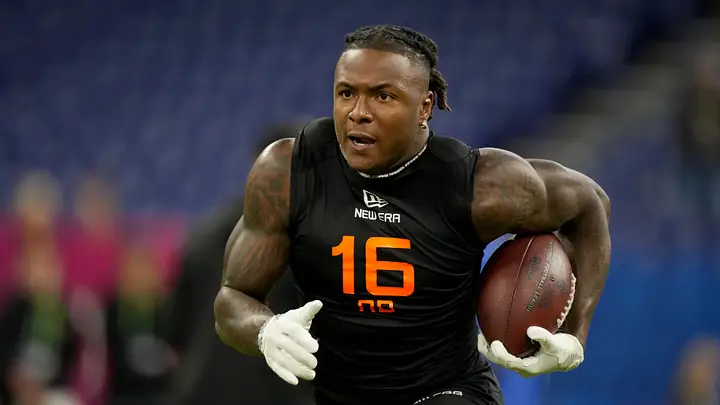
Kaleb Johnson fantasy discussions have become increasingly interesting as the young running back enters another important stage of his NFL career. After a quiet rookie season with the Pittsburgh Steelers, Johnson now has a fresh opportunity with the Green Bay Packers. His impressive college production and physical running style still give fantasy football managers plenty of reasons to keep an eye on him.
Johnson entered the NFL after a spectacular final season at Iowa. In 2024, he rushed for 1,537 yards and 21 touchdowns, establishing himself as one of the most productive running backs in college football. However, his transition to the NFL was far more difficult, with limited opportunities and modest production during his rookie campaign.
Kaleb Johnson’s College Career
Before evaluating Johnson’s fantasy potential, it is important to understand why he attracted so much attention coming out of college.
Johnson spent three seasons at Iowa and finished his college career with 2,779 rushing yards and 30 touchdowns on 508 carries. He also contributed as a receiver, showing that his skill set was not limited to traditional rushing situations.
His 2024 campaign was the clear highlight. Johnson averaged 6.4 yards per carry while producing 1,537 rushing yards and 21 touchdowns. Those numbers demonstrated his ability to combine power, vision and explosiveness.
Johnson developed a reputation as a decisive runner. He could patiently wait for a running lane to develop before quickly accelerating through the opening. Once he reached the second level, his size made him difficult for defenders to bring down.
That combination is one reason his fantasy ceiling remains interesting. Running backs who can consistently gain yards while also possessing touchdown potential can become valuable fantasy players when they receive enough touches.
A Difficult Rookie Season
The biggest concern surrounding the Kaleb Johnson fantasy outlook is his first NFL season.
Johnson appeared in 10 games for Pittsburgh during the 2025 season and recorded only 28 rushing attempts for 69 yards. He also caught one pass for nine yards. His 2.5 yards-per-carry average was obviously disappointing compared with his college production.
However, the small sample size deserves attention.
Johnson did not receive the workload normally associated with a starting running back. He did not make a start and was inactive for Pittsburgh’s final three games of the season. As a result, there simply were not enough opportunities to determine his true NFL ability.
A difficult rookie season does not automatically mean a player’s career is heading in the wrong direction. Young running backs often need time to adjust to professional defenses, blocking schemes and the speed of the NFL game.
For Johnson, the limited workload makes it difficult to draw a firm conclusion from his rookie statistics alone.
A New Opportunity With Green Bay
Johnson’s move to the Green Bay Packers creates a completely different fantasy conversation.
A change of team gives him an opportunity to compete for a new role under a different coaching staff. Instead of being defined entirely by what happened during his rookie season, Johnson now has a chance to establish himself in another offensive system.
That does not guarantee a breakout. Fantasy managers still need to watch his role closely.
The most important question will be whether Green Bay gives Johnson consistent rushing opportunities. If he earns meaningful early-down carries and receives opportunities around the goal line, his fantasy value could rise quickly.
A significant role would give Johnson the opportunity to demonstrate whether the talent he showed at Iowa can translate to the professional level.
Why Johnson Still Has Fantasy Potential
There are several reasons fantasy managers should not overlook Johnson.
His physical profile immediately stands out. Johnson is approximately 6-foot-1 and 224 pounds, giving him the size necessary to handle a substantial rushing workload.
His college production is another major positive. Producing 1,537 rushing yards and 21 touchdowns in a single season is not ordinary. It showed that Johnson could consistently create production when given enough opportunities.
His receiving ability also adds another layer to his potential. Johnson caught 22 passes for 188 yards and two touchdowns during his final Iowa season. While college receiving numbers cannot guarantee NFL production, they demonstrate that he has experience contributing outside the running game.
That matters in fantasy football because receptions can significantly increase a running back’s weekly value, particularly in PPR formats.
The Biggest Concerns
Despite his upside, Johnson should not be treated as a guaranteed fantasy breakout.
The first concern is workload. Talent is important, but fantasy production depends heavily on opportunities. Johnson’s rookie season demonstrated that even a highly regarded young running back can struggle to become fantasy relevant without consistent touches.
Pass protection is another area worth monitoring. Young running backs sometimes struggle to recognize blitzes and protect the quarterback, which can limit their opportunities on passing downs.
If Johnson remains primarily an early-down runner, his fantasy ceiling could be lower than that of a true three-down back.
His rookie efficiency is another question mark. Averaging only 2.5 yards per carry in 2025 is not encouraging, although the extremely small number of attempts makes it premature to treat that figure as a permanent evaluation of his ability.
The new season should provide much more information.
Kaleb Johnson Fantasy Value in 2026
For fantasy managers, Johnson is best viewed as an upside player rather than a safe weekly starter.
His disappointing rookie statistics may cause some fantasy managers to overlook him, but that could create an opportunity for those willing to take a calculated gamble. His college production suggests there is still considerable ability waiting to be unlocked.
The ideal fantasy scenario would involve Johnson becoming part of a significant rushing rotation while receiving consistent red-zone opportunities. If he can establish himself as one of Green Bay’s primary running backs, his value could increase considerably.
On the other hand, fantasy managers should avoid drafting him based solely on his college reputation. His actual role with Green Bay needs to be considered carefully.
Training camp reports, preseason usage and early-season snap counts will be especially important when determining his fantasy value.
PPR vs. Standard Fantasy Formats
Johnson’s potential can vary depending on the scoring system.
In standard formats, his strongest path to fantasy relevance would likely involve rushing volume and touchdowns. His physical running style could make him particularly interesting if he receives goal-line opportunities.
In PPR formats, his ceiling could be higher if his receiving responsibilities increase. Even a few receptions per game could provide valuable additional fantasy points.
His college receiving production suggests that he can contribute in the passing game, but fantasy managers should wait for evidence of consistent NFL usage before assuming he will become a major receiving option.
What Fantasy Managers Should Watch
The most important factor for Johnson will be opportunity.
Fantasy managers should pay attention to how frequently he appears on the field, whether he receives first-team repetitions and how often he handles important situations. Goal-line work could be particularly valuable because touchdowns can quickly change a running back’s fantasy ranking.
His involvement on passing downs will also matter. If the coaching staff trusts him in protection and allows him to run routes, his fantasy ceiling becomes much more attractive.
Another important factor is consistency. One strong preseason performance should not automatically turn Johnson into a must-draft player. Fantasy managers should look for a sustained role rather than isolated highlights.
Frequently Asked Questions
Is Kaleb Johnson a good fantasy football option?
Johnson is currently better viewed as an upside fantasy option than a proven starter. His college numbers were excellent, but his rookie NFL production was limited. His new opportunity with Green Bay makes him a player worth monitoring closely.
What happened to Kaleb Johnson as a rookie?
Johnson played 10 games during his rookie season and received only 28 rushing attempts. He finished with 69 rushing yards and one reception for nine yards. His limited workload made it difficult for him to establish himself as a consistent part of Pittsburgh’s offense.
Why is Kaleb Johnson interesting for fantasy managers?
His combination of size, rushing ability, vision and college touchdown production gives him significant upside. His final season at Iowa was especially impressive, and his receiving experience adds another potential avenue for fantasy production.
Should fantasy managers draft Kaleb Johnson?
Johnson can make sense as an upside selection, particularly if his role with Green Bay becomes clear. However, fantasy managers should avoid treating him as a guaranteed starter until he demonstrates that he can earn consistent NFL touches.
Final Thoughts
The Kaleb Johnson fantasy outlook is ultimately about opportunity. His rookie season was disappointing, but the sample size was too small to erase the impressive talent he demonstrated at Iowa.
Johnson’s college career showed that he can be an explosive and productive runner when given a meaningful workload. His physical size, rushing vision and touchdown ability provide a foundation for fantasy success, while his receiving experience gives him additional upside.
His move to Green Bay could become an important turning point. If he earns a substantial role and receives consistent touches, Johnson has the talent to become a much more interesting fantasy option.
For now, the best approach is cautious optimism. Johnson should not be considered a guaranteed breakout, but he also should not be dismissed because of one limited rookie season. As his role becomes clearer, the Kaleb Johnson fantasy conversation could become one of the more intriguing young-running-back stories of the 2026 season.