


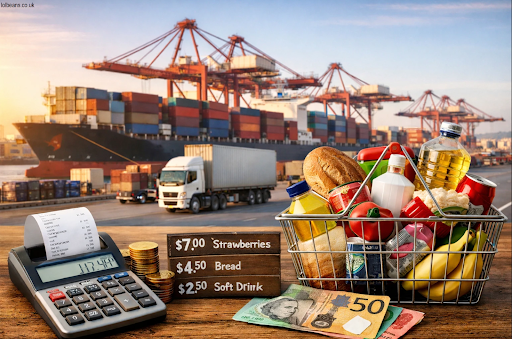
You know that moment at the checkout when you think:
“How did that cost $147.60? I bought food, not a jet ski.”
Yeah. Same.
And while everyone argues about inflation like it’s a mysterious weather pattern, there’s a less glamorous culprit quietly adding dollars to your life:
Containers. And what it costs to move them once they hit Australia.
Not the boat bit.
The Australia bit.
Australia runs on containers (whether we like it or not)
Australia is basically a giant retail island. A lot of what you buy—food, electronics, furniture, hardware, homewares—arrives in a steel box first.
Over 99% of Australia’s international trade moves by sea.
Translation: if it’s physical, it probably had a container phase.
And once that container lands, it still needs to get to a warehouse, then to a store, then to you.
That “last part” is where the hidden tax lives.
The part nobody tells you: “shipping” doesn’t end at the port
Most people hear “shipping costs” and picture a ship.
Cute.
In reality, your stuff gets hit with a stack of costs after it arrives:
- Port + terminal fees (pay to touch the box)
- Booking/access systems (pay to move the box)
- Trucking (pay to transport the box)
- Empty container returns (pay to get rid of the box)
- Compliance bits (biosecurity, fumigation, safety stuff)
And those costs have been climbing in ways that don’t politely reverse next month.
Why 2026 is annoying: it’s not one price rise — it’s a pile-on
The problem isn’t “one big fee went up.”
It’s multiple third-party charges rising at the same time, which compounds fast.
A Melbourne-focused breakdown (and the pattern shows up across major ports and freight corridors) highlights what’s driving the pressure:
- Port/terminal pricing movement (reported range 7%–14%)
- Empty container park fees rising (reported 10%–40% since early 2025)
- Toll exposure increasing (more routes = more toll pain)
- Biosecurity/fumigation services up (reported 15%–20%)
If you’re thinking: “That sounds like death by a thousand admin fees.”
Yes. That’s exactly what it is.
“Cool story. How does that make my cereal expensive?”
Here’s how it works, in plain English:
- Importer buys stuff overseas
- Container arrives in Australia
- Container gets slapped with fees + transport costs
- Importer’s landed cost goes up (that’s the real total cost)
- Wholesale price increases or discounts get weaker
- Retail price rises, shrinkflation happens, and everyone pretends to be shocked
This doesn’t require evil masterminds.
It’s just maths, spreadsheets, and people refusing to lose margin.
The toll thing is bigger than you think
Tolls are brutal because they’re a per-trip cost.
Containers move in trips. Lots of trips.
In Victoria, toll schedules were updated from 1 January 2026 for key corridors.
And industry commentary has flagged potential material impacts on container transport operating costs depending on route/task.
If your supply chain needs to move a box in and out of a port zone repeatedly, tolls don’t “average out.”
They compound. Like a bad decision.
Port charges are the “everyone pays, nobody notices” fee
Ports publish tariff schedules and pricing for services.
And because containers go through ports (shocking), those baseline charges touch everything.
Your $12 face wash and your $900 fridge don’t get charged based on vibes.
They get charged based on systems, fees, and time.
The weirdest cost you’ve never heard of: empty containers
Even after the goods are delivered, the container itself has to be returned, dehired, and repositioned.
That process isn’t free. It involves empty container parks, bookings, handling fees, and time.
And when empty park fees rise sharply (as reported in the Melbourne breakdown), that cost gets baked into the overall transport bill.
Consumers never see an “empty container surcharge.”
They just see “why is a basic lamp $79 now?”
What gets hit first?
Not everything rises at the same time. The fastest pain usually shows up in:
- Essentials with low margins (small cost increases matter more)
- Bulky items (furniture, appliances, building materials)
- Import-heavy categories (electronics, homewares, seasonal stock)
- Discount-driven products (sales get weaker, not always headline price rises)
This is why you’ll notice:
- fewer real bargains
- “specials” that are technically specials but emotionally disappointing
- same price, smaller pack sizes (hello shrinkflation, you thief)
So… are we doomed?
Not doomed. Just mildly mugged.
You can’t control port tariffs or toll networks. But you can reduce how often you get stung:
- Batch purchases when possible (stop paying the delivery machine repeatedly)
- Buy bulky items strategically (timing + local stock matters)
- Don’t fall for “too cheap” imports that end up expensive through delays and rework
- Expect price changes around restocks (new stock lands at new costs)
And if you run a small business importing product, here’s the boring advice that saves money:
Know your landed cost properly. Not just “supplier price + shipping.”
Include local container transport and all the “admin-fee nonsense” in the middle.
The actual takeaway
Australia depends on sea trade. Containers are the bloodstream.
So when the cost to move containers rises—through tolls, port charges, terminals, empty container logistics, compliance—those costs don’t stay in logistics.
They turn into:
- pricier groceries
- weaker discounts
- higher furniture and electronics prices
- more expensive building materials
- and a general sense that money is fake
That’s the hidden shipping tax.
It’s not dramatic. It’s not a headline.
It’s just quietly living in your receipt like it pays rent.