


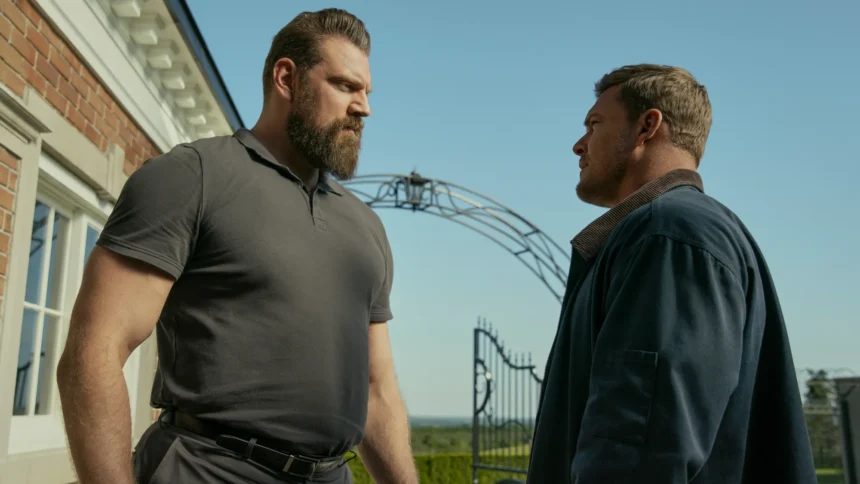
When fans search for an alan ritchson fight, they are usually thinking of the explosive battles that made Jack Reacher one of television’s most convincing modern action heroes. But Ritchson’s ability to make those scenes look powerful did not happen overnight. Years of physical preparation, stunt training, choreography and experience have shaped the way he approaches action on screen.
From his early physically demanding roles to his work as Reacher, Ritchson has developed a reputation for taking fight preparation seriously. His performances are not simply about looking strong. They depend on timing, movement, character and carefully coordinated stunt work.
Why Alan Ritchson Looks So Convincing in a Fight
Alan Ritchson has an unusual advantage when performing action scenes: his physical presence is immediately believable. Standing around 6 feet 3 inches tall and carrying substantial muscle mass for the role of Reacher, he can make even a simple movement appear intimidating.
However, size alone does not explain the effectiveness of his fight scenes.
Ritchson has explained that his previous training included different forms of combat preparation, including work associated with Brazilian jiu-jitsu and brawler-style techniques. For Reacher, however, he had to change many of those habits rather than simply rely on them.
The goal was to create a fighting style that felt efficient and controlled. Reacher does not fight like someone showing off martial-arts techniques. His movements are generally direct, economical and designed to end confrontations quickly. Ritchson has described the process as having to deconstruct some of his previous training and develop a more precise style for the character.
The Training Behind Reacher
Preparing for Reacher required far more than ordinary gym workouts. Ritchson has said that he trained heavily before production and built a home gym during the pandemic when regular gyms were unavailable.
His physical preparation was especially demanding because the character needed to look like the imposing man described in Lee Child’s novels.
Ritchson previously explained that his normal weight was around 205 pounds, while the production wanted him considerably heavier for the role. He trained around five days a week as production approached, combining his physical conditioning with specific fight preparation.
The fight training itself involved unusual situations. Reacher does not always fight with conventional weapons or traditional martial-arts movements. Ritchson had to learn how the character could use everyday objects, including a bicycle tire and necktie, as part of the action.
That attention to detail helped make the character’s combat style feel different from the standard action-hero formula.
The Prison Fight Changed Everything
One of the most memorable early examples of an alan ritchson fight is the prison confrontation from the first season of Reacher.
The sequence was particularly important because it appears early in the story and introduces viewers to how dangerous Reacher can be. Ritchson revealed that the scene received months of preparation because he wanted the choreography to be accurate and repeatable.
The preparation eventually allowed the sequence to be performed repeatedly in a single take. That level of rehearsal is important because action scenes have to look spontaneous while actually requiring extremely precise timing between performers, stunt professionals and cameras.
The result helped establish one of Reacher’s defining characteristics: he does not waste movement.
His opponents may throw wild punches or attempt to overpower him, while Reacher tends to respond with calculated movements. That contrast is central to the character and gives his fights a distinctive rhythm.
Ritchson Has Taken Real Risks on Set
Although movie and television fights are choreographed, they can still be physically dangerous.
Ritchson has openly discussed how demanding some of his action scenes have been. In one particularly memorable Reacher sequence, his character is struck with what was supposed to be a breakaway sugar vase before the fight continues into a pool.
The scene looked convincing because the impact was not completely painless. Ritchson later recalled discovering blood after completing the sequence and realizing that the prop had still caused an actual injury.
That story illustrates an important reality behind action entertainment. What audiences see as a few seconds of violence can require hours of rehearsal and physically exhausting filming.
Actors and stunt performers have to repeat movements from different camera angles while maintaining consistency. Even when safety procedures are carefully followed, the physical demands remain significant.
The Massive Battle With Olivier Richters
Perhaps the most talked-about example of Ritchson’s physical commitment came during Reacher’s third season.
Ritchson faced Olivier Richters, who played Paulie. Richters is approximately 7 feet 2 inches tall, creating an unusual matchup even by action-series standards.
Ritchson recalled being warned about Richters’ extraordinary strength before they began training together. During one early interaction, Richters sent him flying onto a mat, giving Ritchson an immediate idea of what the production had planned for their eventual confrontation.
The fight became one of the production’s largest physical sequences.
According to reports surrounding the season, Richters underwent months of stunt preparation, while the actors had to perform demanding choreography involving multiple locations and difficult physical movements. The battle was designed to feel like a genuine struggle rather than a simple exchange of punches.
That difference matters.
A convincing fight is not necessarily about hitting harder. It is about making the audience believe that both characters are fighting for survival.
What Makes an Alan Ritchson Fight Different
The most effective Ritchson fight scenes usually have a clear character purpose.
Reacher is not portrayed as someone who enjoys violence for its own sake. He tends to become physical when he believes someone has crossed a line or when protecting another person requires it.
That motivation influences how the fights are staged.
His movements are often short and decisive. Instead of performing elaborate combinations simply for visual appeal, the choreography emphasizes Reacher’s strength, intelligence and ability to assess a threat.
The show’s creators have explained that the action team studies the fighting style established in Lee Child’s novels before translating those descriptions into screen choreography. Rehearsals are then filmed and reviewed before the final version is produced.
This process helps preserve the personality of the character within the action.
Alan Ritchson’s Experience Goes Beyond Reacher
Ritchson did not begin his action career with Reacher.
Before taking the role, he had already worked on physically demanding productions, including Titans and the Teenage Mutant Ninja Turtles films. He also played an MMA fighter in Above the Shadows, giving him another opportunity to explore combat performance.
That background explains why he was already familiar with the physical discipline required for action filmmaking.
In an interview with WIRED, Ritchson also discussed his experience training for combat roles and recalled working with former UFC champion Tito Ortiz. He explained that much of his fight preparation is designed specifically for choreography and character work rather than competitive fighting.
That distinction is important. Being capable of performing a convincing screen fight is not the same thing as being a professional mixed-martial-arts competitor.
How Much of the Fighting Is Real?
An alan ritchson fight seen on screen is the result of collaboration between the actor, stunt performers, choreographers, directors and camera crew.
Some movements may be performed by Ritchson himself, while particularly dangerous actions can involve stunt professionals or carefully controlled effects.
Ritchson has nevertheless demonstrated a willingness to perform demanding physical work personally when production conditions allow it.
His approach is especially evident in how much preparation he puts into choreography. He has previously described learning fights under tight production schedules, sometimes practicing shortly before filming the scene.
That workload explains why action stars often describe fight sequences as some of the most exhausting parts of a production.
The Action Keeps Getting Bigger
Ritchson’s physical roles have continued to expand beyond Reacher.
In the 2026 action film War Machine, he performed extensive practical action sequences involving difficult locations and demanding physical situations. Ritchson described the movie’s physical requirements as going beyond what he normally experiences on Reacher, including sequences involving rapids, heights and large-scale practical stunts.
At the same time, Reacher continues to rely heavily on hand-to-hand action. Reporting on the fourth season indicates that the production contains an unusually high number of fights, including a major bowling-alley brawl.
This suggests that Ritchson’s reputation as an action performer is no longer tied to a single character.
Frequently Asked Questions
Does Alan Ritchson know how to fight?
Yes. Ritchson has extensive experience with combat training for acting roles. He has trained in different fighting disciplines and has repeatedly worked with stunt teams to prepare for physically demanding characters. His training is primarily connected to screen performance rather than professional competitive fighting.
Did Alan Ritchson do his own fight scenes in Reacher?
Ritchson performs significant physical and fight work himself, but Reacher’s action sequences are created with professional stunt teams and carefully choreographed for safety. Dangerous movements can involve stunt performers and other controlled techniques.
What was Alan Ritchson’s hardest fight?
There is no single officially designated hardest fight, but his battles with Olivier Richters in Reacher Season 3 were among the most physically demanding. Both performers have discussed the extraordinary physical effort required to create those scenes.
Did Alan Ritchson train for Reacher?
Yes. He underwent extensive physical and fight preparation for the role. His training included strength and conditioning as well as specific choreography designed around Reacher’s distinctive fighting style.
Why are Reacher’s fights so short and powerful?
The choreography is designed around the character’s personality and the fighting style established in Lee Child’s books. Reacher generally uses efficient movements rather than prolonged martial-arts exchanges, allowing his size, timing and precision to become part of the storytelling.
Conclusion
The appeal of an alan ritchson fight goes far beyond seeing a physically imposing actor throw punches. His most memorable action scenes are the result of preparation, choreography, conditioning and a clear understanding of the character.
Ritchson’s years of physical roles gave him a strong foundation, but his work as Reacher required him to refine that experience into something more controlled and precise. From the carefully rehearsed prison fight to his brutal encounters with Olivier Richters, the actor has shown that convincing action requires much more than muscles.
As Ritchson continues taking on increasingly demanding roles, his reputation as a modern action performer is likely to grow. What makes his fights stand out is not simply how powerful they look, but how naturally that physicality fits the characters he plays.