


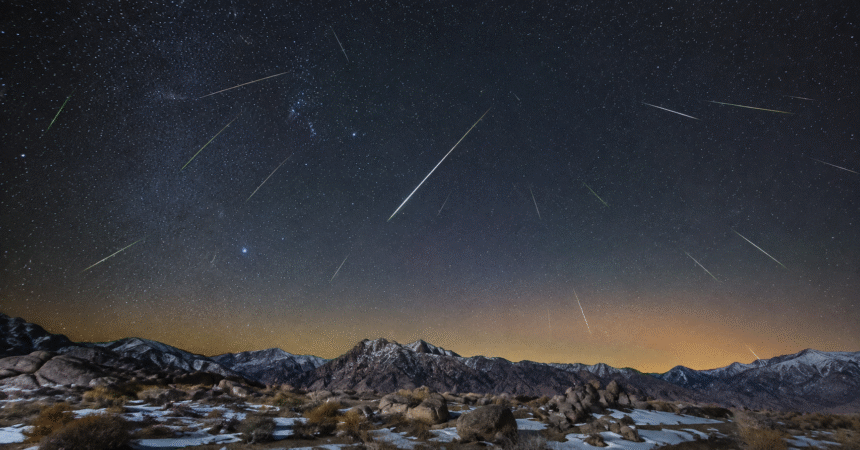
The Quadrantid meteor shower is one of the most unusual and potentially spectacular meteor displays of the year. Appearing in the early days of January, it is famous for producing bright meteors and occasional fireballs, yet its peak lasts only a few hours. That short window makes the shower both exciting and challenging for skywatchers.
Unlike many famous meteor showers that are associated with comets, the Quadrantids are linked to asteroid 2003 EH1, a small object that may itself be related to an ancient comet. The combination of an unusual origin, a brief peak, and strong activity makes this winter meteor shower especially interesting to amateur astronomers and casual stargazers alike.
What Is the Quadrantid Meteor Shower?
The Quadrantid meteor shower occurs every year as Earth passes through a stream of dusty debris left along the orbit of its parent body. When tiny particles enter Earth’s atmosphere at high speed, friction and atmospheric compression heat them until they glow, creating the streaks of light commonly called shooting stars.
The meteors appear to originate from a particular region of the sky known as the radiant. For the Quadrantids, that radiant is located near the constellation Boötes. The shower takes its name from Quadrans Muralis, an obsolete constellation that is no longer officially recognized but remains part of the shower’s historical identity.
The particles responsible for meteor showers are generally extremely small. Many are comparable to grains of sand or small pebbles, meaning they normally burn up completely in the atmosphere rather than reaching the ground. The brilliant streak is therefore not usually caused by a large rock crashing toward Earth, but by a tiny piece of space debris becoming luminous high above the surface.
Why Are the Quadrantids So Special?
One of the biggest attractions of the Quadrantid meteor shower is its potential intensity. Under ideal dark-sky conditions, the shower can produce a high number of meteors during its strongest period. The theoretical peak can reach dozens of meteors per hour, with some estimates considerably higher under perfect conditions.
The unusual feature is that this strong activity does not last very long. The main peak can be concentrated into only several hours. Earth crosses the relatively narrow debris stream at an angle that allows it to move through the densest region quickly.
That creates a fascinating contrast. The Quadrantids can compete with some of the year’s strongest meteor showers, but missing the narrow peak can mean seeing dramatically fewer meteors.
When Does the Quadrantid Meteor Shower Peak?
The shower is generally active from late December into January. Its strongest activity normally occurs during the first few days of January, making it one of the first major astronomical events of the new year.
The exact peak time changes from year to year, and observing conditions can make a major difference. A predicted maximum represents the period when Earth is expected to encounter the densest portion of the debris stream, but it does not guarantee that every observer will see the same number of meteors.
For that reason, skywatchers should consider the broader active period rather than relying entirely on a single hour. Clear skies and a dark location can sometimes matter more than a small difference in the predicted peak.
Where Can You See the Quadrantids?
The Quadrantid meteor shower is particularly favorable for observers in the Northern Hemisphere. The radiant rises higher in the northern sky as the night progresses, making the later nighttime and early-morning hours especially useful for observation.
For the best chance of seeing meteors, move away from bright city lights and find a location with a wide, unobstructed view of the sky. Rural areas, open fields, deserts, beaches, and elevated locations can provide much darker skies than heavily developed areas.
You do not need a telescope. In fact, a telescope can make meteor watching less convenient because its narrow field of view covers only a small section of the sky. Your eyes are better suited to monitoring a wide area.
What Direction Should You Look?
The Quadrantid radiant is located in the northern part of the sky. However, observers should not stare directly at the radiant throughout the entire observation.
Meteors can appear across a large portion of the sky, and their paths seem to spread outward from the radiant because of perspective. Looking somewhat away from the radiant can provide a wider viewing area and make longer meteor trails easier to appreciate.
The radiant becomes more prominent as the night progresses, which is one reason early-morning observation can be more productive than watching shortly after sunset.
The Asteroid Behind the Shower
Perhaps the most intriguing scientific feature of the Quadrantids is their parent object.
Most major meteor showers are associated with comets. The Perseids, for example, are connected with debris from Comet Swift-Tuttle. The Quadrantids, however, are associated with asteroid 2003 EH1.
This object takes approximately five and a half years to orbit the Sun. Scientists have also considered whether 2003 EH1 could be related to an extinct or dormant comet. The exact history of the object and its connection to the Quadrantid debris stream remains an interesting subject of astronomical research.
Studying the debris stream can help scientists understand how small Solar System bodies change over long periods and how ancient material becomes distributed along orbital paths.
Why Moonlight Matters
Even a strong meteor shower can become difficult to observe when the Moon is bright. Moonlight increases the overall brightness of the sky and can hide many of the fainter meteors that would otherwise be visible.
This is an important reason why published meteor rates should be treated as theoretical maximums rather than guaranteed viewing numbers. Light pollution, moonlight, clouds, atmospheric conditions, the observer’s field of view, and the height of the radiant can all affect what people actually see.
A dark, moonless sky can transform the experience. Under good conditions, much fainter meteors become visible, and the overall number of observable streaks can increase significantly.
How to Watch the Quadrantids Comfortably
Watching a meteor shower requires more patience than equipment. A dark location is the most valuable resource, followed by a comfortable position that allows you to look upward without constantly straining your neck.
Winter weather is another consideration. Because the Quadrantids occur around the beginning of January, observers should dress warmly and prepare to remain outside for an extended period. A reclining chair, blanket, or sleeping bag can make a major difference.
Avoid repeatedly checking a bright phone screen because it can interfere with dark adaptation. If you need your phone for astronomy software or a clock, keep the screen dim.
Most importantly, give your eyes time. Meteors are unpredictable, and there may be quiet periods followed by several meteors appearing within a short span.
Can You Photograph the Quadrantids?
Yes, the shower can be photographed with relatively ordinary camera equipment, although capturing meteors requires patience and planning.
A camera capable of manual exposure and a wide-angle lens are useful. A sturdy tripod is important because exposures need to remain stable. Photographers generally aim the camera toward a broad section of the sky rather than trying to predict the exact path of an individual meteor.
The best photographs often come from taking many exposures over a long period. One photograph may contain only stars, while another could capture a bright Quadrantid streak crossing the frame.
FAQ About the Quadrantid Meteor Shower
Is the Quadrantid meteor shower visible every year?
Yes. The shower occurs annually as Earth passes through the relevant debris stream. Its activity generally occurs from late December into January, with maximum activity near the beginning of January.
Do I need a telescope to see it?
No. The Quadrantid meteor shower is best viewed with the unaided eye because meteors can appear across a large area of the sky. A telescope’s narrow field of view can actually make meteor watching less convenient.
Why is the Quadrantid peak so short?
The main reason is the relatively narrow debris stream and Earth’s geometry as it crosses that stream. Earth passes through the densest section relatively quickly, concentrating the strongest activity into only a few hours.
Can people in the Southern Hemisphere see the Quadrantids?
Some activity can be visible, but the shower strongly favors northern observers. The radiant remains relatively low for many southern locations, limiting the number of meteors that can be seen.
Are Quadrantid meteors dangerous?
No. The particles responsible for the visible shower are generally tiny and burn up high in Earth’s atmosphere. Meteor showers are a normal part of Earth’s passage through dusty streams in the Solar System.
Conclusion
The Quadrantid meteor shower stands apart from many other annual meteor displays because of its unusual asteroid association, bright fireballs, and remarkably short period of peak activity. It may not always receive as much attention as the Perseids or Geminids, but under the right conditions it can produce an unforgettable night sky.
The key to seeing it is preparation rather than expensive equipment. Find a dark location, choose a clear night, dress appropriately for winter conditions, allow your eyes to adjust, and be patient.
For anyone interested in astronomy, the Quadrantids offer something especially appealing: a reminder that the night sky can change dramatically from one hour to the next. A few moments of patience may be rewarded with a bright streak traveling across the darkness, carrying with it a tiny piece of the Solar System’s ancient history.